


This paper covers the following topics:
- Section A
- Musical note values — identifying quarter note, quaver, semiquaver, and crotchet rest
- Time signatures — identifying correct time signature from a clapped rhythm; giving reasons
- Indigenous instruments — identifying instruments from images (e.g., drums, string, wind)
- Music software — naming notation software; matching tools (Open, Play, Save, Print) to functions
- Solfa and music concepts — defining melody, rhythm, and transposition
- Speech rhythm and syllabification — analysing a road safety jingle for syllable separation, pitch, and speech accent
- Musical symbols — identifying rests and French rhythm names (ta, ti-ti) for note values
- Dance — identifying the role of drum, movement directions, and body actions (bending, jumping)
- Dynamic markings — meaning of symbols above a musical passage
- Intervals — identifying intervals (C to D = major 2nd; C to G = perfect 5th)
- Section B
- Rhythm in 4/4 — identifying bars with semiquavers and triplets
- Jingle composition — writing syllables, choosing time signature, cadence, anacrusis, lower harmony
- Dance performance — elements of dance, costumes and functions, multimedia effects, safety measures, folk dance identification
- Music festival assessment — distinguishing Kenyan folk songs from Western solo songs, calculating total score and percentage, steps in using notation software.
- Total Marks: 80 (Section A: 30 marks; Section B: 50 marks)
- Structure:
- Section A (30 marks) — Short-answer questions; all compulsory
- Section B (50 marks) — Structured/extended-response and practical questions; all compulsory
- Format: Ms Word
Related products

Grade 10 Exams and Homework
2026 Grade 10 Electricity End of Term 1 Exam with Marking Scheme
KSh50.00

Quick View
Quick View
Grade 10 Exams and Homework
2026 Grade 10 Business Studies End of Term 1 Exam with Marking Scheme
KSh50.00
Quick View
Quick View
Grade 10 Exams and Homework
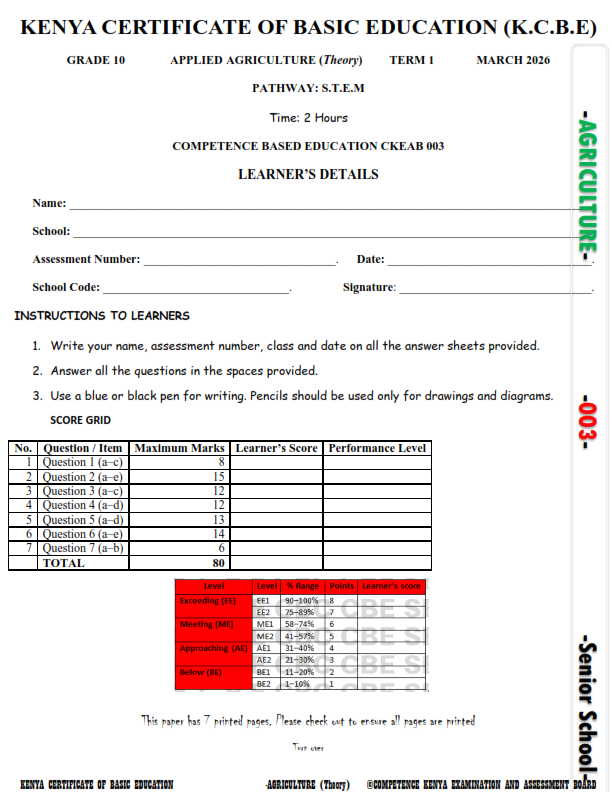
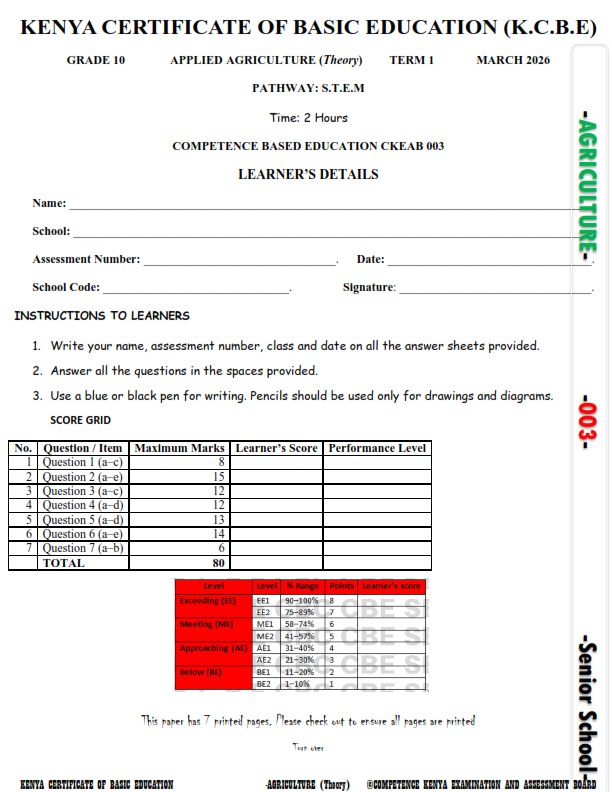
2026 Grade 10 Applied Agriculture End of Term 1 Exam with Marking Scheme
KSh50.00
Quick View
Grade 10 Exams and Homework
2026 Grade 10 Music and Dance End of Term 1 Exam with Marking Scheme
KSh50.00
Quick View
Sale

Grade 10 Exams and Homework
Original price was: KSh600.00.KSh300.00Current price is: KSh300.00.
Quick View
Grade 10 Exams and Homework
2026 Grade 10 General Science End of Term 1 Exam with Marking Scheme
KSh50.00
Quick View
