

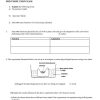
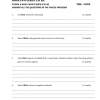
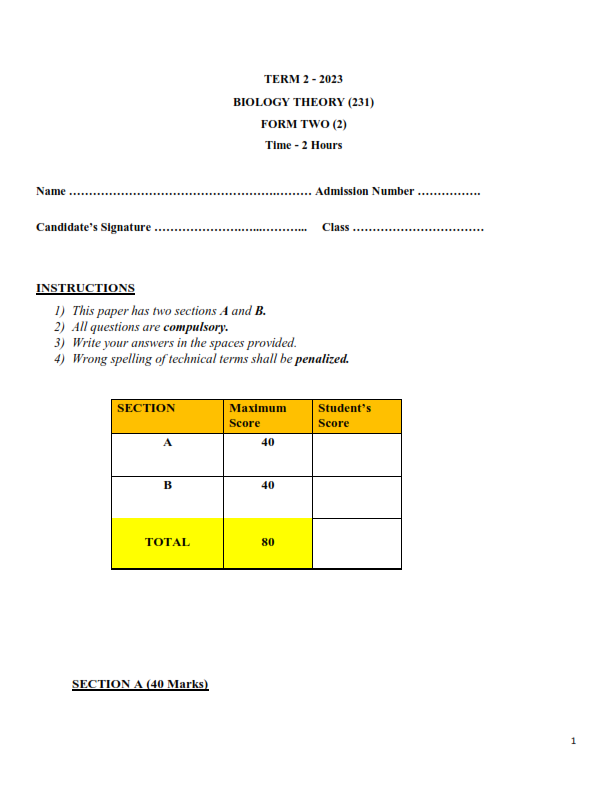
This exam covers:
- Introduction to Biology & Classification:
- Defining Taxonomy and Species.
- The Cell:
- Stating main functions of a microscope.
- Functions and adaptations of the cell wall in plant cells.
- Movement of Substances into and out of Cells:
- Investigating a physiological process (likely osmosis) using a raw potato tuber and glucose solution.
- Explaining results and observations in such an experiment.
- Importance of active transport in living organisms and the role of oxygen concentration.
- Nutrition in Plants and Animals:
- Significance of chlorophyll, stomata, leaf midrib, and veins in photosynthesis.
- Forms in which carbohydrates are stored in plant and animal tissues.
- Calculating the number of teeth from a dental formula.
- Explaining the result of bile duct blockage.
- Identifying the process of peristalsis and the role of dietary components in food movement.
- Distinguishing between homodont and heterodont dentition.
- Stating the function of carnassial teeth.
- Writing a dental formula based on given information.
- Gaseous Exchange:
- Explaining the differences in the percentage composition of carbon (IV) oxide and oxygen in inhaled and exhaled air.
- Respiration/Energy Requirements:
- Explaining why males may require more energy than females after a certain age (based on a table, though part of the question text for 11a is missing).
- Naming other factors (besides sex and age) that determine energy requirements in humans.
- Transport in Plants and Animals:
- Distinguishing between single and double circulatory systems.
- Naming defects of the circulatory system in humans.
- Stating functions of blood other than transport.
- Stating adaptations of xylem to water transportation.
- Enzymes:
- Accounting for the shape of a graph showing the effect of temperature on an enzyme-catalyzed reaction ( denaturation).
- Identifying the optimum temperature for enzyme activity.
- Stating other factors that affect the rate of enzyme-controlled reactions.
Related products
Form 2 Exams and Homework
2023 Form 2 Mathematics End of Term 3 Examination With Marking Schemes
KSh40.00
Quick View

Quick View
Form 2 Exams and Homework
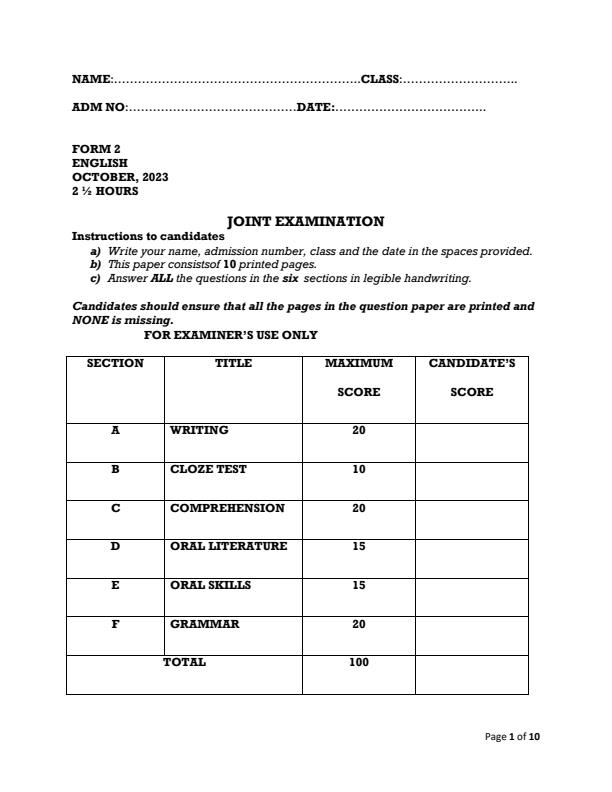
2023 Form 2 English End of Term 3 Examination With Marking Schemes
KSh40.00
Quick View
*Note: Please Click on File Name Below To Download for Free*
(Downloads - 31)
Quick View
Form 2 Exams and Homework
2023 FORM 2 COMPUTER STUDIES MID-TERM 2 EXAMS WITH MARKING SCHEMES
KSh40.00
Quick View


Quick View


Quick View
Form 2 Exams and Homework
2023 Form 2 Agriculture End Term 2 Examination With Marking Schemes
KSh40.00
Quick View
