


This paper covers the following topics:
- Section A
- Sport identification — naming sports from picture cards
- Benefits of sports — matching benefits (cohesion, career, physical health, mental health) to descriptions
- Body composition measurement — uses of tools for measuring body composition
- Injury management — R.I.C.E. principle for sprains, classifying a cut as soft tissue or hard tissue, race safety strategies, emotional effects of long-term injury
- Aerobics — four phases of an aerobics session in order, identifying and describing a floor aerobics movement, dimensions of wellness achieved through group aerobics
- Road safety signs — interpreting road safety signs (true/false)
- Acute vs. chronic injuries — classifying twisted ankle, blisters, and shoulder dislocation
- Coaching — definition of coaching, steps in the coaching cycle
- Sports equipment — naming sports items; identifying sports uses of locally available materials (old tyres, sand-filled containers, sisal rope); qualities of good improvised sports equipment
- Section B
- Sports and recreation data — analysing participation table (identifying highest and lowest activity, calculating total participants), benefits of sports to individuals and community, building a sports culture
- Body composition — calculating BMI, calculating waist-to-hip ratio, distinguishing lean vs. fat body weight, factors determining body composition
- Posture and aerobics — identifying posture types, effects of correct posture on sports performance, calculating total aerobics session time, importance of warm-up and cool-down
- Cycling and coaching — characteristics of a good coach, road safety signs for cyclists, steps in the coaching process
- Aerobics theory — true/false on cool-down, floor aerobics, warm-up, and high-impact aerobics
- Lifting posture — identifying correct lifting posture, effects of incorrect posture on future performance, how correct running posture improves efficiency, causes of postural defects in school
Related products


Quick View
Grade 10 Exams and Homework
2026 Grade 10 Marine and Fisheries End of Term 1 Exam with Marking Scheme
KSh50.00
Quick View

Grade 10 Exams and Homework
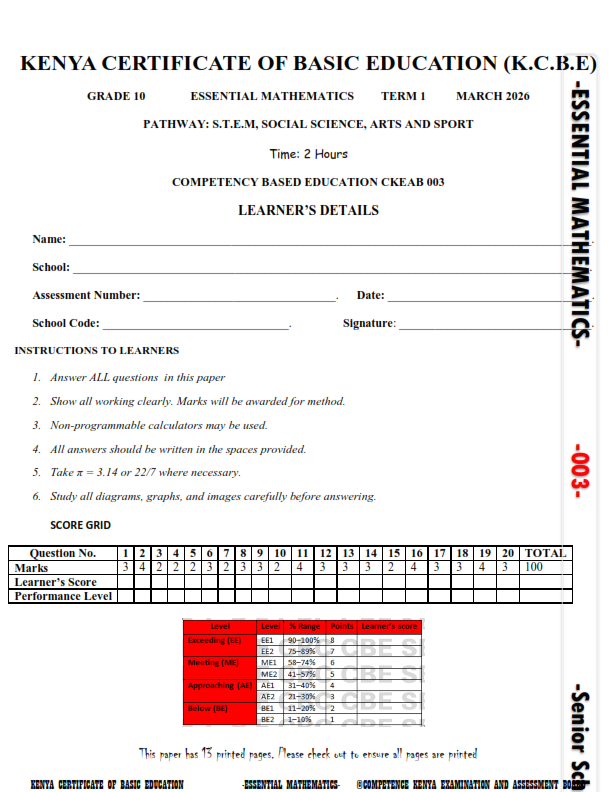
2026 GRADE 10 ESSENTIAL MATHEMATICS END TERM 1 EXAM WITH MARKING SCHEMES
KSh50.00
Quick View

Grade 10 Exams and Homework
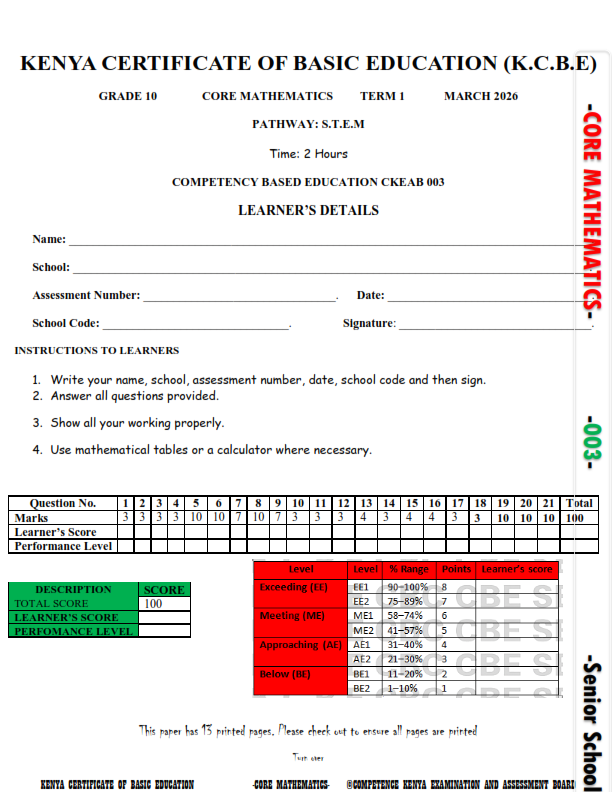
2026 GRADE 10 CORE MATHEMATICS END TERM 1 EXAM WITH MARKING SCHEMES
KSh50.00
Quick View
Grade 10 Exams and Homework
2026 Grade 10 English and Literature End of Term 1 Exam with Marking Scheme
KSh50.00
Quick View
Quick View
Quick View
Quick View
